
- Safeguard-Tree-Services
- 11 Aug, 2026
- 0 Comments
- 17 Mins Read
Can You Build Inside a Tree Protection Zone (TPZ)?
Can You Build Inside a Tree Protection Zone (TPZ)?
Yes, it may be possible to build inside a Tree Protection Zone (TPZ), but whether the proposed work is acceptable depends on much more than simply crossing the TPZ boundary.
A Tree Protection Zone is not automatically a no-build zone. It provides a recognised area around a retained tree within which proposed construction impacts need to be carefully assessed. The extent of the encroachment is important, but so are the location and type of works, the roots that may be affected, the Structural Root Zone (SRZ), existing site conditions and the ability of the tree to remain viable.
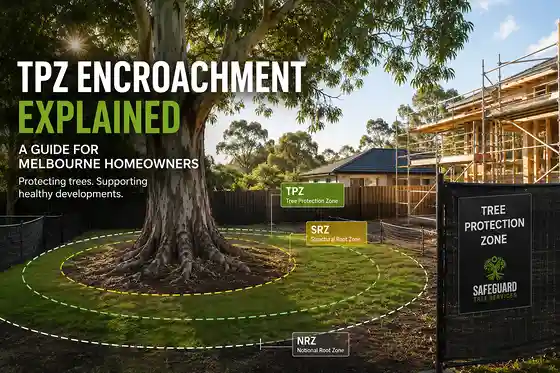
For example, a driveway extending into the outer part of a TPZ may present a very different impact from excavation for a footing close to the trunk—even if both technically occur within the same Tree Protection Zone.
This is why the more useful question is not simply:
“Can I build inside the TPZ?”
It is:
“What impact will the proposed work have on the tree, and can that impact be appropriately managed?”
In Australia, arborists assess these situations using recognised arboricultural principles, including the methodology provided by AS 4970 – Protection of Trees on Development Sites. Depending on the project, this may involve assessing TPZ encroachment, the Structural Root Zone, proposed excavation, existing site conditions, construction methods and, where necessary, investigating the location of significant roots.
In this guide, we’ll explain what it actually means to build inside a Tree Protection Zone, how TPZ encroachment is assessed, the difference between minor, moderate and major encroachment, why the SRZ matters, and what options may be available when construction conflicts with a retained tree.
Whether you’re planning a new home, extension, driveway, swimming pool, retaining wall or larger development, understanding these principles early can help you identify potential conflicts before plans, approvals and construction become more difficult or expensive to change.
What Does Building Inside a Tree Protection Zone Actually Mean?
Building inside a Tree Protection Zone means that part of the proposed development extends into the calculated TPZ of a retained tree. This overlap is generally referred to as TPZ encroachment.
Encroachment can occur in many ways. A house or extension may extend into the TPZ, a driveway may require excavation or preparation within it, or works such as footings, retaining walls, swimming pools and underground services may disturb the surrounding soil.
Importantly, an overlap shown on a development plan does not tell you, by itself, how significantly the tree will be affected.
Consider two proposed works within the same TPZ. One involves excavation for a footing close to the tree, while the other involves construction further from the trunk using a method that limits excavation and root disturbance. Although both are technically TPZ encroachments, the potential impact on the tree may be very different.
It Is Not Just About How Much of the TPZ Is Affected
The amount of TPZ encroachment matters, but it is only one part of the assessment.
An arborist may also consider where the encroachment occurs, whether the Structural Root Zone (SRZ) is affected, the depth and type of excavation required, the likely presence of significant roots, existing site conditions and the health and structural condition of the tree.
Previous disturbance can also be relevant. Existing buildings, driveways, retaining walls or underground services may have already influenced how roots have developed around the site. This is one reason why assessing a tree from a proposed plan alone may not always provide the complete picture.
Where uncertainty exists, further investigation may be required to better understand the location and size of roots before the potential impact of the proposed works can be properly assessed.
If you’re unfamiliar with how these protection areas work, our Tree Protection Zone (TPZ) and Structural Root Zone (SRZ) guide explains how TPZs and SRZs are determined and the different roles they play when development is proposed near trees.
TPZ encroachment identifies where proposed development overlaps a tree's protection zone. It does not automatically mean the development is unacceptable—the extent, location and nature of the potential impact still need to be assessed.
Key Takeaway
How Is TPZ Encroachment Assessed?
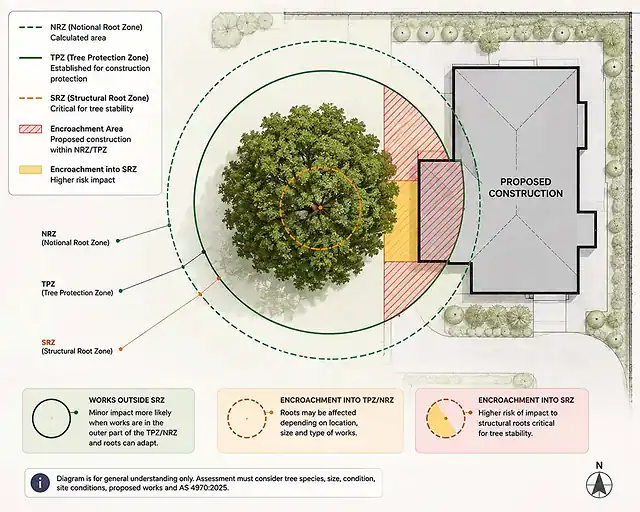
When proposed construction extends into the protection area of a retained tree, arborists assess both the extent of the encroachment and the potential impact on the tree.
Under AS 4970:2025 – Protection of Trees on Development Sites, proposed encroachment is assessed in relation to the tree’s Notional Root Zone (NRZ) and classified as minor, moderate or major.
For homeowners, builders and developers, the important thing to understand is that these percentages are not simply pass-or-fail limits. They help indicate the level of assessment, investigation and tree protection planning that may be required.
Minor Encroachment – Up to 10%
A minor encroachment generally affects 10% or less of the NRZ area, occurs outside the Structural Root Zone (SRZ) and meets the other requirements for minor encroachment under AS 4970:2025.
Minor does not mean that any construction affecting less than 10% is automatically acceptable.
The location of the works, type of construction, excavation required, existing site conditions and previous impacts around the tree still need to be considered.
Where required, an area equivalent to the encroachment may also be incorporated elsewhere within the Tree Protection Zone to avoid a net loss of suitable soil area and volume, unless the Project Arborist can demonstrate that the tree will remain viable without this compensation.
Moderate Encroachment – More Than 10% and Up to 20%
A moderate encroachment generally affects more than 10% and up to 20% of the NRZ area and remains outside the Structural Root Zone.
At this level, the proposed impact requires greater arboricultural consideration.
A Project Arborist may need to investigate the proposed works and determine whether the tree can remain viable. Depending on the site, this could involve reviewing construction methods, modifying the design, investigating roots or introducing specific tree protection measures during construction.
The objective is not simply to justify the percentage of encroachment. It is to understand the likely impact and determine whether the tree can reasonably be retained alongside the proposed development.
Major Encroachment – More Than 20% or Within the SRZ
A major encroachment generally occurs where more than 20% of the NRZ area is affected or proposed works encroach into the Structural Root Zone (SRZ).
This represents a more significant potential conflict between the proposed development and the tree.
However, major encroachment does not automatically mean that the tree must be removed or that the development cannot proceed.
Further arboricultural investigation may be required to understand the likely impact. Depending on the circumstances, this could include root investigation, design modifications, alternative construction techniques, engineering solutions or detailed tree protection measures.
Ultimately, the assessment needs to demonstrate whether the tree can remain viable and appropriately protected if the proposed development proceeds.
Why the Percentage Alone Can Be Misleading
Imagine two proposed developments that each encroach into 8% of a tree’s root protection area.
In the first, the works occur toward the outer portion of the root zone and require relatively little excavation.
In the second, excavation occurs much closer to the trunk and extends into the Structural Root Zone.
On paper, both may appear to involve the same percentage of encroachment. In practice, the potential consequences for the tree can be very different.
This is why arborists don’t assess TPZ encroachment using percentage alone. The extent, location and nature of the proposed works need to be considered alongside the tree, its root system and the existing site conditions.
The 10% and 20% thresholds help classify the extent of encroachment under AS 4970:2025, but they do not provide automatic approval or refusal. The potential impact on the tree still needs to be assessed in the context of the proposed works and the site.
Key Takeaway
What Types of Construction Can Affect a Tree Protection Zone?
Many different types of construction can extend into a tree’s protection area. The potential impact depends not only on how much of the area is affected, but also on what the work involves below ground.
Excavation is particularly important because tree roots can extend through the soil well beyond the trunk. Cutting roots, removing soil, compacting the ground or significantly changing existing soil levels can affect the tree differently depending on where the work occurs and the roots that are present.
Building Footings and Foundations
Footings and foundations can require excavation within the root zone, potentially removing or damaging roots along the building line.
The actual impact will depend on factors such as the location and depth of excavation, the roots present and the proposed foundation system. In some situations, alternative footing or foundation designs may be investigated to reduce disturbance within the root zone.
Driveways and Paved Areas
A new or widened driveway may involve excavation, removal of existing soil, compaction and installation of a pavement profile.
However, not every driveway creates the same level of disturbance. An existing driveway being replaced within an already disturbed area may present different considerations from a new driveway constructed through previously undisturbed soil.
Where tree retention is important, the proposed pavement design, excavation depth and construction method may need to be considered alongside the location of existing roots.
Swimming Pools
Swimming pools can create substantial below-ground disturbance because their construction generally requires significant excavation.
Where a proposed pool extends into a tree’s root zone, the excavation footprint rather than simply the finished edge of the pool may need to be considered. Space required for construction access and associated works can also influence the potential impact on nearby trees.
Retaining Walls and Changes to Ground Levels
Retaining walls can affect trees through excavation for footings, changes to drainage and alterations to the existing soil level around roots.
Both cutting soil away and adding substantial amounts of fill can change the tree’s growing environment. This means the impact of a retaining wall should be considered in relation to the entire proposed construction method rather than its location on a plan alone.
Underground Services and Trenches
Installation of stormwater, sewer, water, electricity and other underground services can require trenching through areas occupied by tree roots.
A relatively narrow trench may appear minor on a site plan, but its impact can be greater if significant roots need to be severed along its path.
Where appropriate, alternative service alignments or installation methods may be considered to reduce unnecessary root disturbance.
Construction Access and Soil Compaction
Not all impacts within a Tree Protection Zone involve excavation.
Repeated movement of vehicles and machinery, storage of building materials and other construction activities can compact soil around a tree. Soil compaction can reduce the pore space available for air and water and adversely affect the tree’s growing environment.
For this reason, tree protection planning considers not only where permanent structures will be located but also how the site will be used while those structures are being built.
A line crossing a Tree Protection Zone on a plan is only part of the picture. The excavation depth, construction method, root disturbance, soil compaction and temporary construction activities can all influence the actual impact on a retained tree.
Key Takeaway
How Can Arborists Investigate Tree Roots Before Construction?
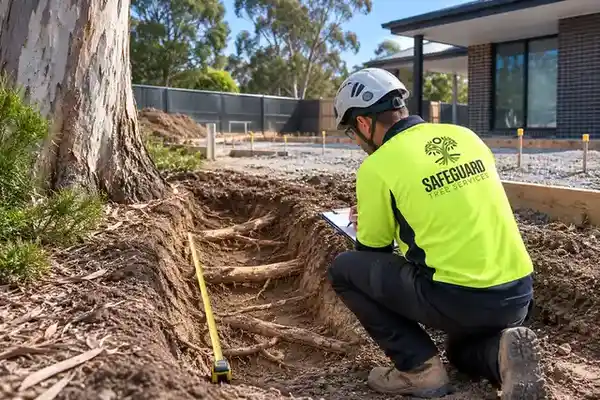
A Tree Protection Zone (TPZ) or Notional Root Zone (NRZ) does not map the exact location of every root beneath the ground. Real root systems can develop unevenly in response to soil conditions, moisture, buildings, paving, retaining walls, underground services and previous disturbance.
This matters when proposed excavation enters a root protection area. A development plan can show how much of the zone is affected, but it may not show what roots are actually present where excavation is proposed.
Where this information could influence an important design or tree-retention decision, targeted root investigation may be appropriate.
What Is a Root Investigation?
Root investigation involves carefully examining a specific area to identify roots that may be affected by proposed works. Depending on the site and purpose, suitable methods may include careful hand excavation, pneumatic excavation, hydraulic excavation or other minimally destructive techniques under appropriate arboricultural supervision.
Roots encountered can be assessed for their location, size and distribution, providing site-specific information about the potential impact of the proposed construction.
For example, if a footing is proposed within a tree’s root zone, investigating along the proposed excavation line may help determine whether significant roots are present. The findings can then help the arborist and project team decide whether the design, footing location or construction method should be reconsidered.
Root investigation does not automatically make an encroachment acceptable. Its purpose is to replace some of the uncertainty with better evidence before important design or tree-retention decisions are made.
Avoid Uncontrolled Excavation Around Roots
Digging a trench with conventional machinery simply to “see where the roots are” can damage the roots before they have been properly assessed.
Where investigation is necessary, its location, extent and method should be appropriately planned so that useful information can be gathered while minimising unnecessary root damage.
TPZ and NRZ calculations identify areas where tree impacts need to be considered, but they do not map individual roots. Where root location could affect a design or tree-retention decision, targeted investigation can provide more site-specific evidence before construction begins.
Key Takeaway
Can a Building Design Be Changed to Reduce TPZ Impacts?
Yes. In some situations, a proposed design or construction method can be modified to reduce impacts on a retained tree.
The best option will depend on the tree, the site and the proposed works, but the aim is generally to reduce how much of the root zone is disturbed, where that disturbance occurs and the amount of excavation required.
Possible design responses may include:
- moving or reshaping part of the building footprint;
- increasing the distance between excavation and the tree;
- reviewing footing or foundation locations with the project engineer;
- changing the alignment or construction method of a driveway;
- relocating underground services away from important roots;
- reducing excavation or changes to existing ground levels; or
- directing works toward previously disturbed areas where appropriate.
For example, if a proposed footing conflicts with significant roots, the project team may be able to investigate whether the building alignment or structural design can be modified. Similarly, a driveway that requires substantial excavation may sometimes be reconsidered to reduce soil and root disturbance.
An arborist does not design the structural solution. Their role is to assess the tree-related constraints and potential impacts so that the architect, designer or engineer can consider appropriate alternatives.
Early Design Gives You More Options
The best time to resolve a TPZ conflict is usually before architectural and engineering plans are finalised.
Once building layouts, footing designs, services and construction details are locked in, making changes can become more complicated and expensive.
Identifying tree constraints early gives the project team an opportunity to consider the tree alongside the development rather than trying to solve a conflict after approvals or construction have already begun.
Building inside a TPZ does not always create an all-or-nothing decision. Where appropriate, changes to the location, excavation or construction method may reduce the impact—but the solution needs to suit the particular tree, site and project.
Key Takeaway
When Should You Speak to an Arborist?
If your proposed construction extends into a Tree Protection Zone, it is generally worth seeking arboricultural advice before the design is finalised or excavation begins.
Early advice can help determine whether the proposed encroachment is likely to require further assessment and whether changes to the design or construction method should be considered.
An arborist may be particularly useful where:
- proposed works encroach into the TPZ or Structural Root Zone (SRZ);
- excavation, footings, retaining walls or underground services are proposed near a retained tree;
- the location of significant roots is uncertain;
- council has requested an arborist report or further tree-related information;
- an Arboricultural Impact Assessment (AIA) is required; or
- construction must occur near trees that are being retained and protected.
Depending on the project, the next step may be relatively straightforward, such as reviewing plans and identifying potential tree constraints. More complex situations may require an arborist report, Arboricultural Impact Assessment, root investigation, Tree Protection Plan or arboricultural supervision during construction.
The important part is timing. Identifying a potential tree conflict while plans can still be changed generally provides more options than discovering the same issue once approvals are underway or construction has started.
If your plans enter a TPZ, seek arboricultural advice early. Understanding the potential impact before the design is finalised can make it easier to investigate practical options and avoid unnecessary problems later in the project.
Key Takeaway
What Should You Do If Your Plans Enter a TPZ?
If a proposed building, driveway, pool or other construction work extends into a Tree Protection Zone, it does not automatically mean the design needs to be abandoned.
The next step is to understand the potential impact before excavation or construction begins.
1. Identify the Affected Trees and Protection Zones
Confirm which trees may be affected and establish the relevant TPZ, NRZ and SRZ measurements. This provides the starting point for understanding how the proposed works interact with the trees.
2. Compare the Protection Zones With Your Plans
Overlay the proposed building footprint, excavation, driveways, services and other works against the tree protection areas. This helps identify where encroachment occurs and which parts of the project may require closer assessment.
3. Assess the Actual Impact
The percentage of encroachment is only part of the picture. Consider the location and depth of excavation, potential root disturbance, existing site conditions and whether the SRZ is affected.
Where important information about root location is unknown, further investigation may sometimes be appropriate.
4. Explore Changes Before Finalising the Design
If a significant conflict is identified, investigate whether the building footprint, excavation, footing locations, driveway, services or construction method can be modified to reduce the impact.
Changes are generally easier to consider while the project is still being designed than after plans and approvals have been finalised.
5. Get Arboricultural Advice Where Needed
Where construction affects a retained tree, the SRZ is involved, council requires documentation or the impact is uncertain, a qualified arborist can assess the proposal and advise on the appropriate next steps.
If your plans enter a TPZ, don't assume you either have to remove the tree or abandon the project. Identify the conflict early, understand the likely impact and explore practical options before construction begins.
Key Takeaway
Frequently Asked Questions
Can You Build Inside a Tree Protection Zone?
Yes, construction may be possible within a Tree Protection Zone, but it depends on the extent and location of the encroachment, the type of work proposed, the tree and its root system, and the site conditions.
Being inside a TPZ does not automatically mean a project is unacceptable. The potential impact needs to be assessed in the context of the individual tree and proposed development.
Is 10% TPZ Encroachment Automatically Allowed?
No. The 10% threshold should not be treated as an automatic allowance to build within a tree’s protection area.
Under AS 4970:2025, encroachment classification considers the affected area and its relationship to the Structural Root Zone (SRZ), along with other relevant requirements. Even where an encroachment is classified as minor, the nature and location of the proposed works still need to be considered.
Can You Build Within a Structural Root Zone (SRZ)?
Encroachment into the Structural Root Zone requires particularly careful assessment because this area relates to roots important for the tree’s structural stability.
Under AS 4970:2025, proposed encroachment into the SRZ is treated as major encroachment. This does not, by itself, determine the final outcome, but it indicates a significant potential conflict requiring appropriate arboricultural assessment.
Can Tree Roots Be Located Before Construction Starts?
In some situations, yes. Targeted root investigation may be used where the location of roots could materially affect a design or tree-retention decision.
The investigation focuses on the particular area of concern rather than attempting to expose the tree’s entire root system. Any investigation should use an appropriate method that minimises unnecessary root disturbance.
Should I Get an Arborist Before Finalising My Building Plans?
If established trees are close to proposed buildings, driveways, pools, retaining walls, services or other excavation, obtaining arboricultural advice early can be valuable.
Identifying tree-related constraints before the design is finalised generally provides more opportunity to investigate practical design or construction responses than discovering the conflict after plans, approvals or construction are already underway.
Planning Construction Near Existing Trees?
Building inside a Tree Protection Zone does not automatically mean your project cannot proceed. What matters is understanding the extent and location of the encroachment, the type of construction proposed and how the works may affect the tree.
The earlier these issues are identified, the more opportunity there may be to investigate practical options before the design is finalised or construction begins.
If you’re planning a new home, extension, driveway, swimming pool, retaining wall or development near existing trees, Safeguard Tree Services can provide arboricultural advice to help you understand the tree-related constraints affecting your project.
Our arboricultural services include TPZ and SRZ assessments, arborist reports, Arboricultural Impact Assessments (AIA), root investigations and tree protection advice for residential, commercial and development projects across Melbourne’s south-east.
Not sure how a tree affects your proposed development? Contact Safeguard Tree Services to arrange an arboricultural assessment and understand your options before moving forward.