- Safeguard-Tree-Services
- 04 Aug, 2026
- 0 Comments
- 15 Mins Read
Tree Protection Zones (TPZ) & Structural Root Zones Explained
Tree Protection Zones (TPZ) & Structural Root Zones Explained
Understanding Tree Protection During Construction and Development
Who is this guide for?
This guide is designed for homeowners, builders, developers, architects, landscape designers, property owners and anyone wanting to understand how construction and development can affect existing trees. Whether you’re planning a home extension, new driveway, swimming pool, subdivision or commercial project, this article explains Tree Protection Zones (TPZ) and Structural Root Zones (SRZ) in clear, practical language.
You’ll learn what these zones are, why they matter, how arborists assess them, and how they help protect trees while supporting well-planned development.
Introduction
If you’re planning construction or development near existing trees, you’ve likely come across the terms Tree Protection Zone (TPZ) and Structural Root Zone (SRZ) in an arborist report, planning application or council documentation. Understanding what these terms mean is an important first step in making informed decisions about your project.
While trees add significant environmental, aesthetic and economic value to a property, they can also influence where and how development takes place. Much of a tree’s critical structure lies below the ground, where roots provide stability while absorbing water and nutrients. Activities such as excavation, trenching, soil compaction and changes to ground levels can damage these roots, sometimes without any immediate visible signs.
This guide explains the principles behind Tree Protection Zones and Structural Root Zones, how they are used in arboricultural assessments, and why they play an important role in balancing responsible development with the long-term retention of suitable trees.
Understanding Tree Roots
Before learning about Tree Protection Zones (TPZ) and Structural Root Zones (SRZ), it’s helpful to understand how trees grow below the ground. Although we often judge a tree by its trunk, branches and canopy, its root system is just as important for its health, stability and long-term survival.
Unlike many people imagine, tree roots do not grow deep into the ground like the roots of a carrot. In most soil types, the majority of a tree’s root system develops within the upper layers of soil, where oxygen, moisture and nutrients are most readily available. From this network of roots, the tree absorbs water and minerals, stores energy and anchors itself against wind and other environmental forces.
Not all roots perform the same function. Broadly speaking, a tree’s root system contains two important groups of roots:
Structural Roots
Structural roots are the larger woody roots that extend from the base of the trunk. Their primary role is to anchor the tree securely in the ground and provide mechanical stability. These roots help resist movement caused by strong winds, uneven loading and the natural weight of the tree.
Damage to major structural roots can reduce a tree’s stability and, depending on the extent of the damage, increase the likelihood of structural failure.
Absorbing Roots
Absorbing roots, sometimes referred to as fine roots, are much smaller and are responsible for taking up water and nutrients from the soil. Although they are relatively small in diameter, they perform a vital role in supporting the tree’s ongoing health and growth.
Because these roots are concentrated close to the soil surface, they are particularly vulnerable to construction activities such as excavation, soil compaction, trenching, stockpiling of materials and repeated vehicle traffic.
Why Tree Roots Matter During Construction
Construction activities often focus on what is happening above the ground, but many of the most significant impacts occur below the surface. Even when the trunk and canopy remain untouched, disturbing the root system can affect the tree’s ability to remain healthy and structurally stable.
For this reason, arborists assess not only the visible parts of a tree but also the area surrounding its root system when planning development. Tree Protection Zones (TPZ) and Structural Root Zones (SRZ) provide a practical framework for identifying these areas and managing potential impacts during construction.
Now that we’ve explored how tree roots function below the ground, let’s look at how arborists use this knowledge to establish a Tree Protection Zone.
A healthy tree depends on both its above-ground structure and its underground root system. Understanding how roots function is essential to understanding why Tree Protection Zones (TPZ) and Structural Root Zones (SRZ) are used in arboriculture.
Key Takeaway
What Is a Tree Protection Zone (TPZ)?
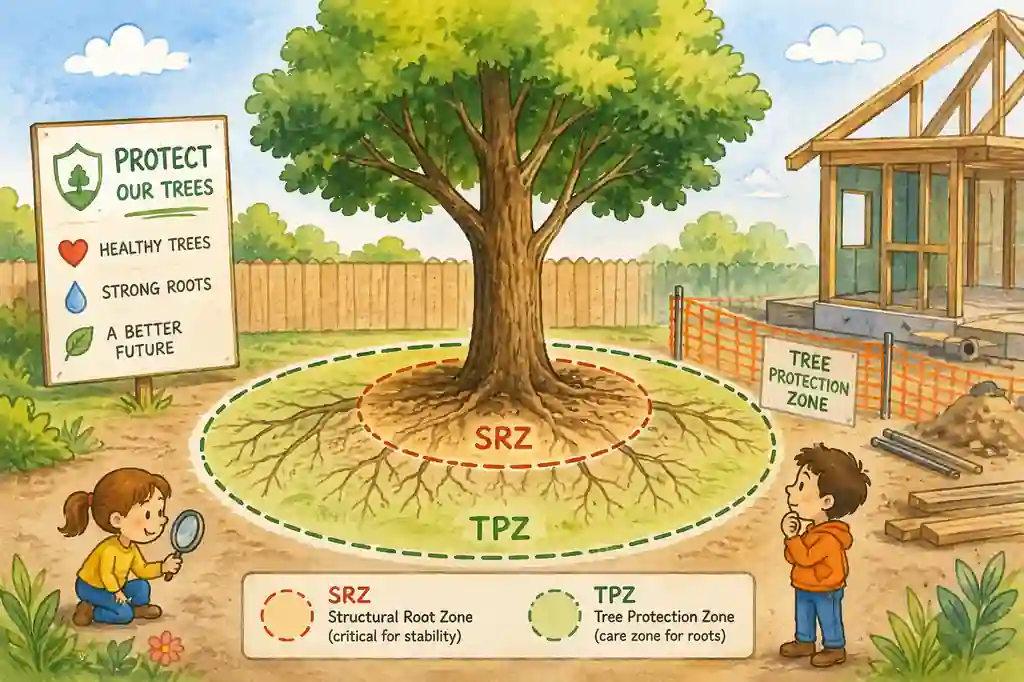
A Tree Protection Zone (TPZ) is a designated area surrounding a tree that helps protect the roots and growing environment during construction and development. It is one of the most important tools arborists use to assess how nearby works may affect a retained tree.
Think of a TPZ as a “care zone” around a tree. It identifies the area where construction activities should be carefully planned and managed to reduce the risk of damaging the tree’s root system.
Why Is a TPZ Important?
Although the trunk and canopy are the most visible parts of a tree, many of the roots responsible for supporting its health extend well beyond the base of the trunk. Construction activities within this area can damage roots, compact the soil or change the growing conditions the tree relies upon.
A TPZ helps arborists, designers and builders identify where these impacts are most likely to occur so they can make informed decisions before construction begins. This may include adjusting building footprints, modifying excavation methods, installing tree protection fencing or adopting alternative construction techniques.
Importantly, a TPZ is not a “no-go zone” where all work is prohibited. Instead, it is a planning and assessment tool that helps determine whether proposed works are likely to affect the tree and what measures may be be appropriate to minimise those impacts.
How Is a TPZ Determined?
A Tree Protection Zone (TPZ) is not estimated by eye or based on the size of the tree canopy. Instead, arborists use a recognised methodology to calculate a recommended protection area around a retained tree.
In Australia, Tree Protection Zones are generally determined in accordance with AS 4970 – Protection of Trees on Development Sites. The calculation is primarily based on the trunk diameter of the tree, measured at a specified height above ground level. This measurement is then used to calculate a TPZ radius, which provides a consistent starting point for assessing potential impacts from nearby development.
However, the calculated TPZ is not the final answer. Every tree grows in a unique environment, and arborists use professional judgement to interpret the calculated protection zone. Factors such as the tree’s species, age, health, structure, previous disturbances, site conditions and the proposed construction activities may all influence the final assessment and management recommendations.
What Happens Inside a TPZ?
Working within a Tree Protection Zone does not automatically mean a project cannot proceed. Depending on the circumstances, an arborist may recommend modifications to construction methods or protective measures that reduce potential impacts on the tree.
Examples may include:
- Installing tree protection fencing before works begin.
- Using non-destructive excavation methods where appropriate.
- Avoiding unnecessary soil compaction from heavy machinery.
- Protecting exposed roots during approved excavation.
- Adjusting the design to reduce impacts on retained trees.
Every project should be assessed on its own merits, taking into account the tree, the site and the proposed development.
While a TPZ considers the broader growing environment, arborists also assess another important area that focuses specifically on structural stability.
A Tree Protection Zone (TPZ) is a planning tool used by arborists to help identify and manage potential impacts on retained trees during construction and development. It supports informed decision-making rather than automatically preventing development.
Key Takeaway
What Is a Structural Root Zone (SRZ)?
While a Tree Protection Zone (TPZ) helps protect the overall health and growing environment of a tree, a Structural Root Zone (SRZ) focuses on something more specific—the roots that are critical for keeping the tree standing.
Think of the SRZ as the tree’s foundation. Just as a building relies on strong foundations for stability, a tree depends on its structural roots to remain securely anchored in the ground.
Why Is an SRZ Important?
The large structural roots located close to the trunk play a vital role in supporting the tree’s weight and resisting forces such as strong winds. Damage to these roots may reduce the tree’s structural stability and, depending on the extent of the damage, increase the likelihood of failure.
For this reason, arborists pay particular attention to activities that may affect the area immediately surrounding the trunk, especially where excavation or major ground disturbance is proposed.
The Structural Root Zone generally occupies the area immediately surrounding the trunk because it focuses specifically on the roots that contribute most to the tree’s structural stability.
How Is an SRZ Determined?
In Australia, the Structural Root Zone is generally determined using the methodology outlined in AS 4970 – Protection of Trees on Development Sites. Like the TPZ, it is calculated using recognised arboricultural principles rather than visual estimation.
The calculated SRZ provides a guide to the area containing the tree’s critical structural roots. Arborists then consider the characteristics of the individual tree, the site conditions and the proposed development when assessing potential impacts and recommending appropriate protection measures.
Why the SRZ Deserves Special Attention
Although work may sometimes be considered within parts of a Tree Protection Zone, disturbance within the Structural Root Zone requires particularly careful assessment because of the important role these roots play in maintaining tree stability.
Protecting the Structural Root Zone helps reduce the risk of compromising the tree’s ability to remain safely anchored while also supporting its long-term retention where appropriate.
A Structural Root Zone (SRZ) identifies the area containing the tree's most important structural roots. Protecting this zone helps maintain the tree's stability and is a key consideration when planning construction near retained trees.
Key Takeaway
TPZ vs SRZ: What's the Difference?
Tree Protection Zones (TPZ) and Structural Root Zones (SRZ) are both used by arborists when assessing the potential impacts of construction near retained trees. Although they are closely related, they serve different purposes and should not be confused.
A Tree Protection Zone (TPZ) is concerned with protecting the tree’s overall health by identifying the area where construction activities may affect its root system and growing environment.
A Structural Root Zone (SRZ) focuses specifically on protecting the roots that are critical to the tree’s structural stability and ability to remain safely anchored.
Neither zone replaces the other. Instead, they are used together to help arborists understand potential risks and recommend appropriate tree protection measures during planning and construction.
TPZ and SRZ Compared
| Tree Protection Zone (TPZ) |
|---|
| Protects the tree’s overall health. |
| Covers the broader growing environment. |
| Helps assess the effects of construction on retained trees. |
| Used to guide planning and tree protection measures. |
| Structural Root Zone (SRZ) |
|---|
| Protects the tree’s structural stability. |
| Covers the area containing critical structural roots. |
| Helps assess the risk of damaging roots essential for stability. |
| Used to protect the tree’s structural foundation. |
Why Arborists Assess Both
A tree needs both a healthy root system and a stable foundation to thrive. Looking at only one protection zone would provide an incomplete understanding of how construction may affect the tree.
By assessing both the Tree Protection Zone and the Structural Root Zone together, arborists can provide balanced recommendations that help reduce unnecessary impacts while supporting responsible development and the long-term retention of suitable trees.
A TPZ helps protect the tree's health, while an SRZ helps protect its stability. Together, they provide a practical framework for assessing construction impacts and planning appropriate tree protection measures.
Key Takeaway
How TPZ and SRZ Are Used During Development
Tree Protection Zones (TPZ) and Structural Root Zones (SRZ) are more than theoretical concepts. They are practical tools used by arborists to assess potential impacts, guide project planning and help protect suitable trees throughout the development process.
Rather than asking, “Can this project proceed?”, arborists assess a more practical question:
“How can this project proceed while reducing unnecessary impacts on retained trees?”
Every site is different, so there is no one-size-fits-all solution. Instead, arborists consider the proposed development alongside the tree’s characteristics, site conditions and applicable standards before providing recommendations.
During the Planning Stage
Before construction begins, TPZ and SRZ assessments help identify potential conflicts between proposed works and existing trees. This allows designers, architects and property owners to make informed decisions early in the design process, when changes are often simpler and more cost-effective.
Examples include:
- Positioning buildings further from significant trees.
- Adjusting driveway or pathway alignments.
- Relocating underground services where practical.
- Identifying trees suitable for retention or removal.
During Construction
Once construction begins, TPZ and SRZ assessments help guide on-site tree protection measures. Depending on the project, an arborist may recommend:
- Installing tree protection fencing before works commence.
- Restricting vehicle access around retained trees.
- Avoiding unnecessary soil compaction.
- Supervising excavation near retained trees.
- Protecting exposed roots where approved works are undertaken.
The recommendations vary depending on the project and should always be based on the specific circumstances of the site.
After Construction
Tree protection does not necessarily end when construction is complete. Newly retained trees may continue to respond to changes in their growing environment over time. In some situations, follow-up inspections or ongoing monitoring may help identify issues early and support the tree’s long-term health.
Why Early Arborist Advice Matters
Many conflicts between development and existing trees can be reduced through early planning. Seeking arboricultural advice during the design stage often provides greater flexibility than attempting to address tree-related issues after construction has commenced.
Early assessments can help identify opportunities to retain suitable trees while supporting practical and well-informed development outcomes.
TPZ and SRZ assessments help guide decisions before, during and after construction. By considering tree protection early in the planning process, property owners and project teams are often better placed to balance development with the long-term retention of suitable trees.
Key Takeaway
Common Misconceptions About TPZ and SRZ
Tree Protection Zones (TPZ) and Structural Root Zones (SRZ) are often misunderstood. Misconceptions can lead to unnecessary concern, poor planning or decisions that may unintentionally affect the health or stability of retained trees.
Let’s look at some of the most common myths.
Myth 1: A TPZ Means You Can’t Build
Reality: A Tree Protection Zone is not a “no-build zone”. It is a planning and assessment tool that helps arborists evaluate how proposed works may affect a retained tree. In some situations, construction within a TPZ may be possible when appropriate assessment, planning and protection measures are implemented.
Myth 2: Tree Roots Grow Straight Down
Reality: Many tree roots develop within the upper layers of soil where oxygen, moisture and nutrients are most readily available. Root depth and spread vary depending on the tree species, soil conditions and growing environment.
Myth 3: Bigger Trees Always Have Bigger TPZs
Reality: While trunk diameter plays an important role in determining a Tree Protection Zone, arborists also consider the individual characteristics of the tree and the proposed development when providing professional advice.
Myth 4: The TPZ and SRZ Are the Same Thing
Reality: Although they are related, they serve different purposes. A Tree Protection Zone helps protect the tree’s overall health and growing environment, while a Structural Root Zone helps protect the roots that are critical to the tree’s structural stability.
Myth 5: Every Tree Is Assessed the Same Way
Reality: No two trees are exactly alike. Arborists assess each tree individually, taking into account its size, species, age, condition, growing environment and the proposed works before providing recommendations.
Understanding the facts behind TPZ and SRZ helps property owners, builders and developers make more informed decisions. Professional arboricultural assessments consider the unique characteristics of each tree and each development project rather than relying on assumptions.
Key Takeaway
Frequently Asked Questions
Does every tree have a Tree Protection Zone (TPZ) and Structural Root Zone (SRZ)?
Yes. Every tree has a root system that supports its health and stability. The size of the TPZ and SRZ varies depending on the individual tree and the recognised assessment methodology.
Who determines a TPZ and SRZ?
Tree Protection Zones and Structural Root Zones are typically determined by a qualified arborist as part of an arboricultural assessment. The calculations are based on recognised Australian methodologies and are interpreted in the context of the individual tree, site conditions and proposed development.
Does a Tree Protection Zone mean I can’t build?
Not necessarily. A TPZ is not automatically a no-build zone. It is a planning tool that helps arborists assess potential impacts and recommend practical measures to help protect retained trees during construction.
Can a TPZ or SRZ change?
The calculated TPZ and SRZ are determined using recognised methodologies. However, an arborist’s recommendations may vary depending on the tree’s condition, site characteristics and the nature of the proposed works.
Why do councils request arborist reports?
Councils may request an arborist report to understand how a proposed development could affect existing trees. These reports help support informed planning decisions and may include TPZ and SRZ assessments where relevant.
What This Means for You
Understanding Tree Protection Zones (TPZ) and Structural Root Zones (SRZ) is about more than learning new terminology. These concepts help explain how trees interact with construction and development, why arborists make certain recommendations, and how thoughtful planning can support both successful projects and the long-term retention of suitable trees.
Whether you’re planning a home extension, a new driveway, a swimming pool, a subdivision or a larger development, understanding TPZs and SRZs allows you to make more informed decisions before work begins. By considering tree protection early in the planning process, many potential issues can be identified sooner, giving you greater flexibility to explore practical solutions while reducing unnecessary impacts on retained trees.
Every tree, every site and every project is unique. While this guide provides a general understanding of Tree Protection Zones and Structural Root Zones, site-specific advice should always be based on a professional assessment of the individual tree and the proposed works.
Planning a Project Near Existing Trees?
If you’re unsure how existing trees may affect your project, obtaining professional arboricultural advice early can help you move forward with confidence.
Safeguard Tree Services provides arboricultural assessments, Tree Protection Zone (TPZ) and Structural Root Zone (SRZ) evaluations, Arborist Reports, Arboricultural Impact Assessments and practical tree protection advice for residential, commercial and development projects throughout Melbourne’s south-east.
Whether you’re a homeowner, builder, architect or developer, we’re here to help you understand your options and support informed planning from the very beginning.
Need advice for your project? Contact Safeguard Tree Services to arrange a professional arboricultural assessment or request a free on-site consultation.