- Safeguard-Tree-Services
- 20 Aug, 2026
- 0 Comments
- 4 Mins Read
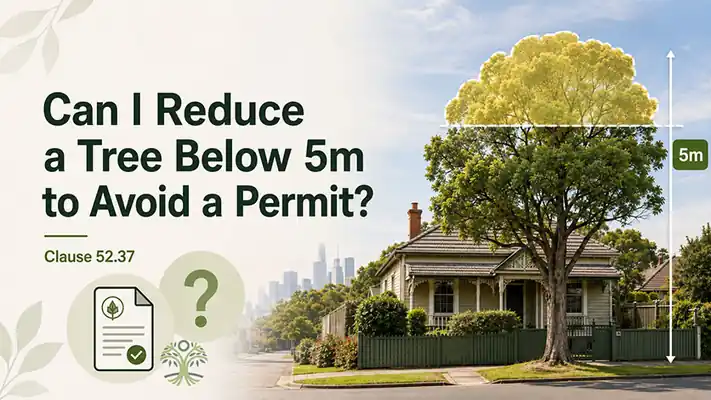
Can I Reduce Tree Height Below 5m to Avoid a Permit? | Clause 52.37
Can I Reduce Tree Height Below 5m to Avoid a Permit? | Clause 52.37
If a tree on your property is only slightly taller than 5 metres, you may wonder whether reducing its height to below 5 metres means it will no longer require a planning permit.
Under Clause 52.37 – Canopy Trees of the Victorian Planning Provisions, you should not assume that pruning a tree below the 5 metre threshold will avoid a permit requirement.
Clause 52.37 includes an exemption for certain maintenance pruning. However, that exemption specifically does not apply where the pruning or lopping would reduce the height of the tree to less than 5 metres, or reduce its canopy diameter to less than 4 metres.
What Is a Canopy Tree Under Clause 52.37?
Clause 52.37 defines a canopy tree as a tree that has all of the following:
- a height of more than 5 metres above ground level;
- a trunk circumference of more than 0.5 metres, measured at 1.4 metres above ground level; and
- a canopy diameter of at least 4 metres.
All three criteria must be satisfied for a tree to meet the Clause 52.37 definition of a canopy tree.
Can I Reduce a Canopy Tree Below 5 Metres?
Not under the maintenance-pruning exemption if the proposed pruning would reduce the tree to less than 5 metres in height.
Clause 52.37 provides an exemption for lopping or pruning a canopy tree for maintenance only, provided that no more than one-third of the foliage is lopped or pruned.
Importantly, the clause states that this exemption does not apply to:
- pruning or lopping the trunk of a canopy tree;
- pruning or lopping that would reduce the tree’s height to less than 5 metres; or
- pruning or lopping that would reduce the tree’s canopy diameter to less than 4 metres.
This means that simply reducing a qualifying canopy tree below 5 metres should not be treated as a way of automatically avoiding the requirements of Clause 52.37.
Does That Mean a Permit Is Always Required?
Not necessarily.
Whether Clause 52.37 requires a permit depends on more than the height of the tree.
Clause 52.37 requires a permit to remove, destroy or lop a canopy tree in the:
- Mixed Use Zone;
- Township Zone;
- Residential Growth Zone;
- General Residential Zone;
- Neighbourhood Residential Zone; and
- Housing Choice and Transport Zone,
unless an applicable exemption applies.
For land developed with an existing dwelling, Clause 52.37 also provides that the permit requirement does not apply to a canopy tree that is not a boundary canopy tree.
A boundary canopy tree is a canopy tree where any part of its trunk is within:
- 6 metres of the narrowest street frontage of the lot; or
- 4.5 metres of the rear boundary of the lot.
The requirements can be different for vacant land or where development is proposed.
Example: A Tree Just Over 5 Metres
Consider a tree that is:
- 5.5 metres high;
- has a trunk circumference of 0.7 metres at 1.4 metres above ground; and
- has a canopy diameter of 4.5 metres.
Based on these measurements, the tree meets the Clause 52.37 definition of a canopy tree.
If the proposed pruning would reduce the tree from 5.5 metres to 4.8 metres, the maintenance-pruning exemption cannot be relied upon simply because less than one-third of the foliage may be removed. The exemption expressly excludes pruning that reduces the tree’s height to less than 5 metres.
Whether a planning permit is ultimately required would still depend on how Clause 52.37 applies to the particular property, tree and proposed works, including whether another exemption applies.
What About Normal Maintenance Pruning?
Clause 52.37 does allow certain maintenance pruning without a permit under the clause.
The exemption applies to pruning or lopping for maintenance only, where no more than one-third of the tree’s foliageis removed.
However, the work cannot rely on this exemption if it involves trunk pruning or reduces the tree below the specified 5 metre height or 4 metre canopy diameter thresholds.
Therefore, the amount of foliage being removed is not the only consideration when assessing whether the maintenance exemption applies.
Check Before Significant Height Reduction
If a tree is close to the Clause 52.37 thresholds, it is sensible to establish the tree’s dimensions and check the planning controls affecting the property before significant pruning or height reduction is undertaken.
Clause 52.37 is also not the only planning provision that may regulate trees. Other applicable planning controls or overlays may need to be considered separately. The Victorian Government confirms that Clause 52.37 operates alongside other relevant planning provisions.
Where there is uncertainty about whether a planning permit is required, confirmation should be obtained from the relevant responsible authority before works commence.
Frequently Asked Questions
Is every tree over 5 metres protected by Clause 52.37?
No. A canopy tree must satisfy all three criteria under Clause 52.37: height, trunk circumference and canopy diameter. The permit requirement must also apply to the particular property and circumstances.
Can I prune less than one-third of a canopy tree?
Clause 52.37 contains a maintenance-pruning exemption where no more than one-third of the foliage is removed. However, the exemption has additional limitations, including that the pruning must not reduce the tree below 5 metres in height or below 4 metres in canopy diameter.
Can I prune a 5.5 metre tree down to 4.8 metres?
If the tree meets the Clause 52.37 definition of a canopy tree, the maintenance-pruning exemption does not apply to pruning that would reduce its height to less than 5 metres. Whether a permit is required still depends on the circumstances of the property, tree and proposed works.
Who should I check with before pruning?
If there is uncertainty about the planning requirements affecting a tree, check with the relevant council or responsible authority before undertaking the work.
This article provides general information about Clause 52.37 of the Victorian Planning Provisions and should not be relied upon as legal or planning advice. Planning requirements depend on the individual property, tree and proposed works and may include other provisions of the relevant planning scheme. Current requirements should be confirmed with the relevant responsible authority before undertaking tree removal or significant pruning.
Important Information