- Safeguard-Tree-Services
- 17 Mar, 2026
- 0 Comments
- 8 Mins Read
When Should a Tree Be Removed? Melbourne Arborist Guide (2026)
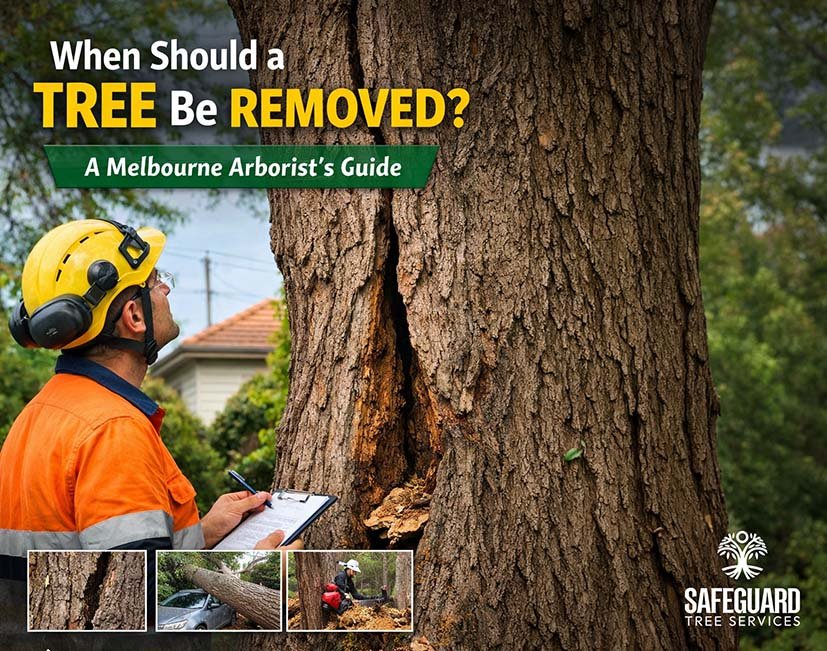
When Should a Tree Be Removed? (Melbourne Arborist Guide 2026)
Not every tree needs to be removed. But in some situations, removal is the safest and most practical option. Knowing when that point is reached can help you avoid costly damage, reduce risk, and protect your property and the people around it.
In Melbourne, trees are often growing close to homes, driveways, fences, and powerlines. Because of this, it is important to recognise when a tree may no longer be safe or suitable to keep.
In this guide, we will walk you through the key signs to look for, when a tree can be retained, and how a qualified arborist decides whether removal is necessary.
Tree Removal vs Tree Retention
A lot of people think arborists just remove trees. That is not how it works.
A good arborist will always look at whether a tree can be kept first. Removal is usually the last option and is only recommended when there is a clear reason.
Tree removal is generally considered when:
The tree poses an unacceptable safety risk
The structure of the tree is compromised
The tree is in the wrong location for its size or species
Keeping the tree is no longer practical due to building or site constraints
If the risk can be managed, the tree is often worth keeping.
7 Signs a Tree May Need Removal
Understanding when a tree needs to be removed is not always straightforward. Some issues are obvious, while others develop slowly over time. Below are the most common signs we look for during a professional tree inspection.
1. The tree is dead or declining
A tree that is dead or in serious decline is one of the clearest indicators for removal. You might notice reduced leaf growth, large sections of dead branches, or ongoing dieback through the canopy.
In many cases, declining trees will not recover, especially if the issue has progressed over several seasons. As the structure weakens, the timber becomes brittle and more prone to failure. This increases the risk of branches dropping or the entire tree failing without much warning.
2. Cracks in the trunk or major branches
Visible cracks or splits in the trunk or main limbs should always be taken seriously. These are structural defects that can worsen over time, particularly with wind movement or additional weight from the canopy.
Even if the tree appears stable, internal stress may already be present. In some cases, failure can occur suddenly, especially during storms or strong winds. A proper assessment is important to determine how severe the defect is.
3. The tree is leaning more than usual
Not all leaning trees are a problem. Some species naturally grow at an angle and remain stable for many years. The concern comes when a tree develops a new lean or when an existing lean becomes more pronounced.
Signs to look for include soil lifting around the base, cracking in the ground, or exposed roots. These can indicate that the root system is failing, which significantly increases the likelihood of the tree falling.
4. Root damage
The root system is critical for both stability and overall tree health. Damage to roots can occur during construction, excavation, trenching, or even repeated vehicle traffic over the root zone.
When roots are compromised, the tree may lose its ability to anchor properly. This can lead to instability, decline in health, and in some cases, complete failure. Root damage is one of the most common contributing factors in tree-related incidents.
5. Signs of decay or fungus
Fungal growth around the base, trunk, or major limbs can be a sign of internal decay. While some trees can tolerate minor decay, more advanced cases can significantly weaken the structure.
The challenge is that decay is often not visible externally. A tree may still appear healthy with a full canopy, while the internal wood is compromised. This is why professional inspection is important when fungal activity is present.
6. Storm damage
After strong winds or storms, trees can suffer damage that is not always obvious straight away. Broken branches, torn bark, and partially failed limbs can create weak points within the structure.
Even if the tree remains standing, the damage may increase the likelihood of future failure. It is always a good idea to have trees inspected after major weather events, especially if they are close to buildings or high-use areas.
7. Tree is too close to structures
Trees growing too close to houses, garages, fences, or driveways can become an issue over time. As the tree matures, both the canopy and root system expand, which can lead to conflicts with surrounding structures.
This may include overhanging branches, root intrusion, or increased risk if the tree were to fail. In some cases, removal becomes the most practical option when the tree has outgrown its location.
When a Tree Can Be Retained
Not every issue means a tree needs to be removed. In many cases, trees can be safely managed and continue to provide value to your property for years to come.
A professional arborist will always look at retention first before recommending removal. The goal is to reduce risk while maintaining the health, structure, and amenity of the tree wherever possible.
Depending on the condition of the tree, this may involve a combination of management techniques.
Common options include:
Pruning to remove deadwood or reduce weight in heavy limbs
Canopy reduction to minimise wind load and stress on the structure
Installation of support systems such as cabling or bracing
Ongoing monitoring to track changes over time
Each tree is different, and the right approach depends on the species, condition, and location. A proper assessment will determine whether the risk can be reduced to an acceptable level or if removal is the safer option.
How Arborists Assess Tree Risk
Tree risk assessment is a structured process. It is not based on guesswork or quick visual opinions.
Arborists follow recognised industry methods to assess both the condition of the tree and the level of risk it presents. This helps ensure that recommendations are consistent, justified, and defensible.
When assessing a tree, three main factors are considered.
1. Likelihood of failure
This looks at how likely the tree, or part of it, is to fail. Structural defects such as cracks, decay, or root damage all influence this.
A tree with significant internal decay or instability will have a higher likelihood of failure than a healthy, well-structured tree.
2. Likelihood of impact
This considers what the tree could hit if it fails. A tree in an open paddock presents a very different level of risk compared to one located next to a house, driveway, or public area.
The more frequently people or property are present, the higher the likelihood of impact.
3. Consequences of failure
This looks at what would happen if failure occurs. Minor branch drop in a low-use area may have minimal impact, while failure near a house or vehicle can result in significant damage or injury.
These three factors are combined to determine the overall risk level. Based on this, the arborist will recommend whether the tree can be retained, requires management, or should be removed.
Legal Considerations in Melbourne
Tree removal in Melbourne is not always a simple decision. In many cases, approval is required before any work can be carried out.
Depending on the property and the tree, this may involve:
Council permits
Planning overlays or canopy tree controls
Recent changes to planning laws have increased the level of protection for larger trees across many residential areas. This means even trees in your own backyard may require approval before removal.
Removing a tree without the correct permissions can lead to fines, delays in building approvals, or complications when selling your property.
If you are unsure, it is always best to check with your local council or speak with a qualified arborist before proceeding.
Cost vs Risk
It is common for property owners to delay dealing with a problem tree, especially if it still appears to be in reasonable condition.
However, leaving issues too long can increase both the risk and the cost.
Taking action early can help:
Prevent damage to buildings, fences, and vehicles
Avoid emergency call-outs after storms
Reduce the overall cost of removal or maintenance
On the other hand, ignoring warning signs can lead to more serious outcomes, including structural damage or safety hazards.
In most cases, planned work is always more cost-effective than reactive emergency work.
Real Example from Melbourne
We recently inspected a large pine tree in Melbourne’s south-east. From the outside, the tree appeared healthy, with a full green canopy and no obvious signs of decline.
During a closer inspection, significant internal decay and cracking were identified within the main trunk. These defects were not visible from a distance but had a major impact on the tree’s structural integrity.
The tree was located close to a driveway and within falling distance of the house. Based on its condition and location, the risk was considered unacceptable.
Although the tree still looked healthy, removal was recommended as the safest and most appropriate option.
How Safeguard Tree Services Can Help
t Safeguard Tree Services, we take a practical and honest approach to every job.
Our focus is not just on removing trees, but on providing the right advice based on safety, condition, and long-term outcomes.
We can assist with:
Professional tree inspections and risk assessments
Arborist reports for council applications
Tree pruning and ongoing maintenance
Safe, efficient, and compliant tree removal
We work across Melbourne and understand local council requirements, which helps ensure the process is smooth and stress-free for our clients.
Frequently Asked Questions
Do all damaged trees need to be removed?
No. Many trees can be managed with the right pruning or maintenance. Removal is only recommended when the risk cannot be reduced to an acceptable level.
How do I know if my tree is dangerous?
Some issues are obvious, but many are not visible without experience. A professional inspection is the safest way to assess the condition and risk.
Do I need council approval to remove a tree?
In many cases, yes. This depends on the size of the tree, its location, and any planning controls that apply to your property.
Is it cheaper to remove a tree early?
In most situations, yes. Early removal is usually simpler, safer, and avoids the higher costs associated with emergency work.
Trees add value, shade, and character to any property, but they do require proper management.
Knowing when a tree should be removed comes down to a combination of safety, structural condition, and location. Getting professional advice early allows you to make informed decisions and avoid unnecessary risks.
If you are unsure about a tree on your property, a simple inspection can provide clarity and peace of mind.