Clause 52.37 Explained: Do I Need a Permit to Remove My Tree in Melbourne?
Clause 52.37 Explained: Do I Need a Permit to Remove My Tree in Melbourne?
Updated: 22 Oct 2025
From 15 September 2025, Clause 52.37 – Canopy Trees introduces new tree-removal permit requirements across Victoria. If you’re a homeowner or builder in Melbourne, this guide explains what counts as a canopy tree, when a permit is required, and how to stay compliant.
What changed on 15 September 2025?
The new Clause 52.37 – Canopy Trees applies to residential land within the following planning zones: MUZ, TZ, RGZ, GRZ, NRZ and HCTZ. These changes make certain trees on both vacant and developed lots subject to planning approval before removal. Because the clause is new, councils are still refining interpretations, but the triggers below provide a reliable starting point. Read Clause 52.37 – Canopy Trees on the official Victorian Planning Schemes site
Key point: A planning permit—either via the VicSmart or standard pathway—authorises tree removal. A building permit alone does not.
What is a “Canopy Tree”?
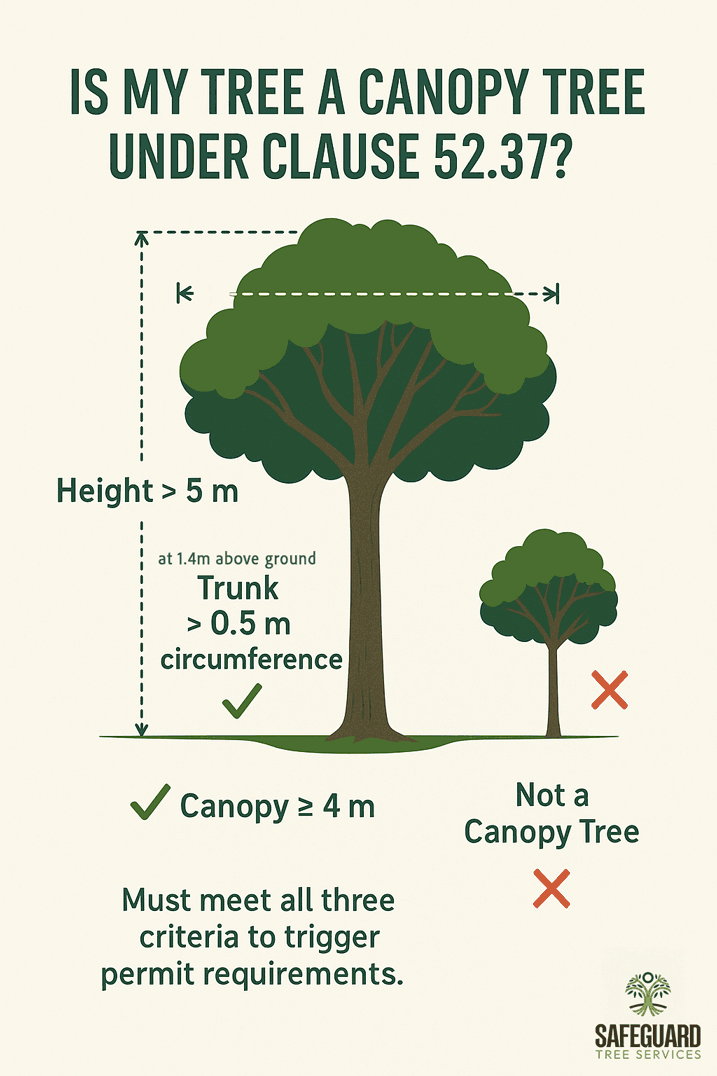
A tree is considered a Canopy Tree when all the following are true:
- Height > 5 m
- Trunk circumference > 0.5 m (measured 1.4 m above ground)
- Canopy diameter ≥ 4 m
Notes: For multi-stemmed trees, at least one stem must exceed 0.5 m; stems aren’t added together. The measurement “greater than 0.5 m” means 0.51 m or more. A 4 m canopy is measured across the dripline in one cardinal direction.
What is a “Boundary Canopy Tree”?
Boundary Canopy Trees are Canopy Trees whose trunks are located within specific setback distances:
- Within 6 m of the front boundary (facing the street)
- Within 4.5 m of the rear boundary
All Boundary Canopy Trees are Canopy Trees, but not all Canopy Trees are boundary trees.
When is a permit required?
A) Canopy Trees
A permit is required to remove, destroy, or lop a Canopy Tree anywhere on the lot if:
- The land is vacant, or
- The land is vacant and a new single dwelling is proposed (with only a building permit required).
B) Boundary Canopy Trees
A permit is required to remove, destroy or lop a Boundary Canopy Tree (within 6 m front / 4.5 m rear) if:
- An existing dwelling has no development proposed, or
- An existing dwelling is being extended, or
- The site is vacant and a planning permit application is being assessed for one or more dwellings, or
- A planning permit application is being assessed for additional dwellings on the lot.
Tip: Ask your arborist to map trees on a scaled site plan to confirm whether they fall within these setback zones.
How do setbacks work on different block types?
Standard blocks
Front boundary faces the street; rear is opposite. Trees within 6 m (front) or 4.5 m (rear) require a permit.
Corner blocks
The shorter street frontage is the front; if equal, council decides. Rear is opposite the front (the longest opposite side). 6 m / 4.5 m rules apply.
Oddly shaped blocks
The front faces the street; the rear is the most distant boundary (or longest if several). 6 m and 4.5 m rules still apply.
Transitional provisions: Do the new rules apply to me?
You may be exempt if before 15 Sept 2025:
- A building permit was issued (or within 12 months after, with a surveyor appointed or substantial design progress certified)
- A planning permit was granted
- A planning application was lodged
- Another permit already allowed removal
- Your site is within a DPO or IPO approved before the change
Exemptions and routine pruning
Common exemptions include:
- Dead trees
- Emergency works (tree poses immediate risk)
- Declared noxious weeds in Victoria
- Maintenance pruning up to one-third of foliage (without reducing below 5 m height or 4 m canopy)
Clause 52.37 does not override all other planning controls—vegetation overlays, bushfire clauses, and local laws may still apply.
Minimum canopy tree requirements for new development
New developments must meet minimum tree numbers based on lot size. If you’re below the threshold, replacement planting is usually required.
- 201–500 m² → 3 Canopy Trees
- 501–700 m² → 4 Canopy Trees
- 701–1000 m² → 6 Canopy Trees
- 1001 m² + → Canopy cover equal to 20% of site area
Can a building permit authorise tree removal?
No. Tree removal must first be authorised by a planning permit (VicSmart or standard). Only after that can a building permit rely on it.
Learn more about the VicSmart planning permit process
What should I include in a Clause 52.37 application?
- Site plan showing all trees and those proposed for removal
- Photos (full tree, trunk at 1.4 m, canopy spread)
- Reason for removal (health, damage, design constraints)
- Development plans if relevant
- AQF Level 5 arborist assessment (if health or stability is the reason)
- Replacement planting plan with species list and soil volumes
Council considerations before approval
- Tree health and stability
- Damage risk to buildings or infrastructure
- Number and location of trees retained
- Design minimises tree loss
- Cumulative impact of recent removals
Frequently Asked Questions
Do I need a permit if my tree is exactly 5 m tall?
No. The definition requires a height greater than 5 m. If it’s exactly 5 m, that criterion isn’t triggered (but check trunk and canopy dimensions).
What if my multi-stemmed tree has no single trunk over 0.5 m?
Only one trunk needs to exceed 0.5 m circumference at 1.4 m above ground. Stem sizes can’t be added together.
Can I prune one-third without a permit?
Yes—routine maintenance pruning up to one-third of foliage is exempt, as long as you don’t prune the trunk or reduce the tree below 5 m height or 4 m canopy.
Does Clause 52.37 override overlays and local laws?
No. Other planning overlays and local laws may still apply in addition to Clause 52.37, depending on your site.
Need Expert Help?
Safeguard Tree Services provides AQF Level 5 assessments and permit-ready reports for Clause 52.37 across Melbourne’s south-eastern suburbs. We’ll measure, map and advise you on compliance — and manage the entire application for you.
*Legal Disclaimer*
*This article provides general information based on Clause 52.37 – Canopy Trees (effective 15 September 2025) and is intended for educational purposes only. It does not constitute legal or planning advice. Regulations and council interpretations may change over time. Property owners and developers should confirm specific requirements with their local council or engage an AQF Level 5 arborist or planning consultant before undertaking any tree works or lodging a permit application.*