Boundary Canopy Trees & Setbacks (6 m Front / 4.5 m Rear) — Made Simple
Boundary Canopy Trees & Setbacks – Clause 52.37 Explained (Victoria 2025)
Updated 22 October 2025 | Safeguard Tree Services
The Victorian Government’s new Clause 52.37 – Canopy Trees introduces tree-protection rules that affect many homeowners and developers across Melbourne. This guide explains what Boundary Canopy Trees are, how the 6 m (front) and 4.5 m (rear) setbacks work, and when you do or don’t need a planning permit for tree removal.
What is a Boundary Canopy Tree?
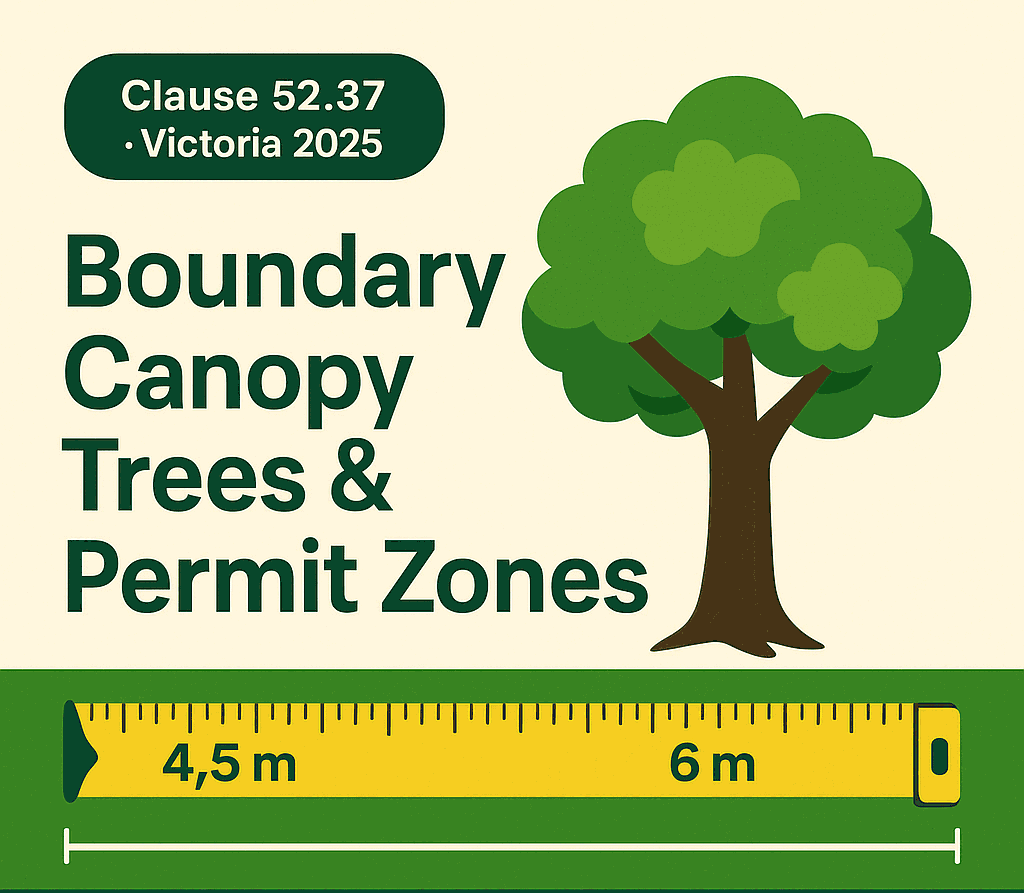
A Boundary Canopy Tree is a canopy tree whose trunk lies within specific distances of your property boundaries:
- Up to 6 metres from the front boundary (the street frontage)
- Up to 4.5 metres from the rear boundary
All Boundary Canopy Trees are Canopy Trees, but not all Canopy Trees are Boundary Canopy Trees. Location determines which rules apply.
How to measure the setbacks
Measure horizontally from the legal boundary line —not from the fence or building. Use a scaled site plan or surveyor’s data for accuracy, especially if a tree sits close to the trigger lines.
Boundary Canopy Trees & Permit Zones
🏡 Lot layout at a glance
| Zone | Distance from boundary | Permit | Notes |
|---|---|---|---|
| 🟡 Front Zone | Within 6 m of the front boundary (street side) | ✅ Required | Classified as Boundary Canopy Tree |
| ⚪ Middle Zone | Beyond 6 m (front) and 4.5 m (rear) | 🚫 Usually No | For existing dwellings; still check overlays/Local Laws |
| 🟢 Rear Zone | Within 4.5 m of the rear boundary | ✅ Required | Classified as Boundary Canopy Tree |
📏 How to measure correctly
- Measure from the legal title boundary, not from the fence or house.
- Corner sites: the shorter street frontage is the front boundary (ties decided by Council).
- Irregular lots: rear is the boundary most distant from the front (use the longest opposite segment).
- Use a scaled plan/survey if a tree is close to a trigger line.
🧱 Permit requirements by site type
| Site condition | Rule summary | Permit? |
|---|---|---|
| 🏗️ Vacant land | Removing/lopping any Canopy Tree anywhere on site | ✅ Yes |
| 🏡 Existing dwelling | Only trees within 6 m front / 4.5 m rear zones | ✅ Yes |
| 🏡 Existing dwelling | Canopy trees outside those zones | 🚫 Usually No |
| 📄 Planning application lodged | All Canopy Trees proposed for removal (anywhere) | ✅ Yes |
🌿 Quick definitions
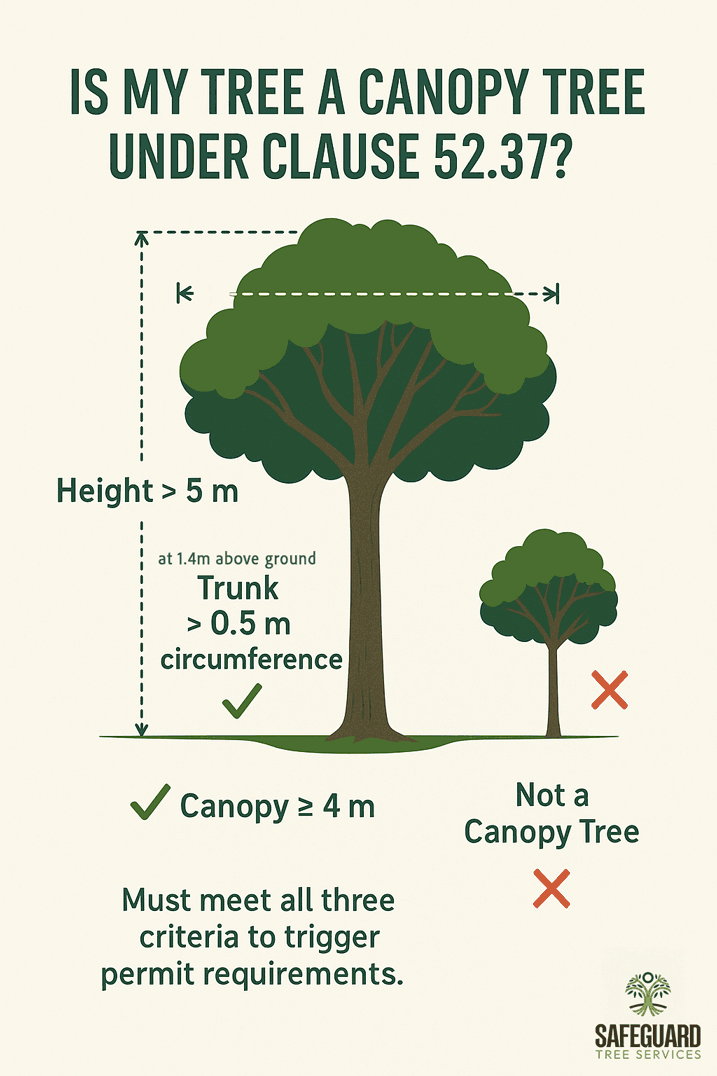
- Canopy Tree — Height > 5 m; trunk circumference > 0.5 m at 1.4 m; canopy diameter ≥ 4 m (all three must be met).
- Boundary Canopy Tree — Any Canopy Tree within 6 m of front or 4.5 m of rear boundary.
- No Permit Zone — Middle area outside the front/rear bands on developed lots (subject to other controls).
⚠️ Common mistakes to avoid
- Measuring from the fence, not the legal boundary.
- Assuming corner lots have two front boundaries.
- Ignoring overlays (VPO, SLO, ESO) or Local Laws.
- Undertaking works before planning approval is issued.
✅ Key takeaways
- Vacant land → permit for all Canopy Trees.
- Existing dwellings → permit only in front/rear zones.
- Planning application lodged → permit for any Canopy Tree proposed to remove.
- Always confirm with Council or an AQF Level 5 Arborist.
Understanding the zones
Clause 52.37 creates three practical zones on most residential lots:
- Front Zone (6 m) – Trees in this band are Boundary Canopy Trees and usually require a permit to remove or lop.
- Middle Zone – Canopy trees outside the front/rear setbacks are generally exempt on developed lots (but check for overlays or Local Laws).
- Rear Zone (4.5 m) – Trees within this band are Boundary Canopy Trees and usually require a permit.
Do I need a permit if it’s a canopy tree but not within boundary zones?
Whether you need a permit depends on your land type and what’s proposed.
Vacant land
✅ A permit is required to remove, destroy or lop any Canopy Tree anywhere on a vacant lot—even if it’s outside the boundary zones.
Existing dwelling
❌ If a dwelling already exists and no new development is proposed, Clause 52.37 applies only to Boundary Canopy Trees within the 6 m (front) and 4.5 m (rear) bands. Trees outside those distances typically do not require a permit, unless other planning overlays or Local Laws apply.
Planning application lodged
✅ If you’ve lodged a planning application for new buildings or units, Clause 52.37 covers all Canopy Trees proposed for removal — regardless of their distance from boundaries.
Summary table
| Site condition | Tree location | Permit needed? |
|---|---|---|
| Vacant land | Anywhere on site | ✅ Yes |
| Existing dwelling | Within 6 m (front) / 4.5 m (rear) | ✅ Yes |
| Existing dwelling | Outside those zones | ❌ Usually No (check overlays / Local Laws) |
| Planning permit lodged | Anywhere | ✅ Yes |
Example: A River Red Gum 12 m from both boundaries on a developed lot is a canopy tree but not a boundary tree — so no Clause 52.37 permit is required unless other controls apply.
Corner and irregular lots
On corner sites, the shorter street frontage is the front boundary. If both are equal, Council may nominate the front. The rear is opposite the front and, if multiple segments exist, the longest segment is treated as the rear. The same 6 m (front) and 4.5 m (rear) bands apply.
Documentation for permit applications
- Scaled site plan showing boundaries, setback bands and tree positions
- Photos (whole tree, trunk at 1.4 m, canopy spread)
- AQF Level 5 arborist assessment if health or stability is the reason for removal
- Replacement planting schedule if required to meet minimum canopy numbers
Common questions about Boundary Canopy Trees
How do I measure the 6 m front and 4.5 m rear zones?
Measure from the legal boundary lines of the property, not from the house or fence. If any part of the trunk sits inside these bands, it’s a Boundary Canopy Tree.
Do side boundaries matter?
No. Clause 52.37 only uses front and rear setbacks to define Boundary Canopy Trees. Side boundaries may still be relevant under other overlays.
What if the tree is exactly on the 6 m or 4.5 m line?
If any part of the trunk is within that distance, it is treated as a Boundary Canopy Tree and may require a permit. Confirm with a survey or council planner.
Can I prune instead of remove?
Maintenance pruning of up to one-third of the foliage is exempt, provided you don’t cut into the trunk or reduce the tree below 5 m in height or 4 m in canopy spread.
Need help navigating the new rules?
Safeguard Tree Services provides AQF Level 5 arborist reports and permit-ready site plans to help homeowners and developers stay compliant under Clause 52.37 throughout Melbourne’s south-eastern suburbs.
Book a consultation → | Arborist reports | Tree removal | Tree pruning
Legal Disclaimer
This article is for general information only and does not constitute legal or planning advice. Council interpretations and regulations may change. Always confirm requirements with your local Council or consult an AQF Level 5 arborist before undertaking any tree works or lodging a planning application.